
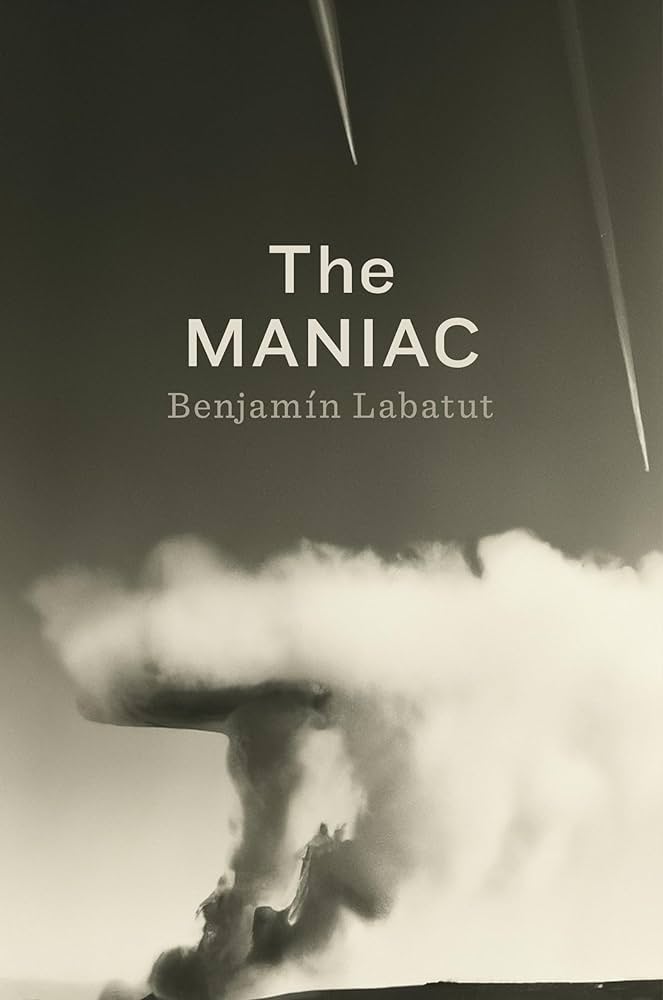
Some books take you from reality and transport you to a strange new world, showing you how life could have been different in some lost universe. But others show you the world for how it is and how terrible the world could have been if not for a handful of people. The Maniac, by Benjamin Labatut, is one of those generational books that completely altered how I think about the world and how it functions.
The Maniac is about John Von Neuman, a prominent mathematician and physicist best known for his work in the Manhattan project, and how his alien genius was able to influence almost every aspect of the modern age, from computers and AI to medicine and global warming. Neuman was an extremely gifted individual, who quickly rose through the ranks of American high society, eventually creating and controlling of some of the most important technological inventions in the 20th century. This power, supplemented by the ego of not thinking but knowing you’re the smartest person in any room, created toxic relationships and nearly world ending consequences.
As he continued down this path of success and luxury, Neuman began to contemplate ideas that were at the forefront of human thinking, which began to take a toll on him. He became obsessed with ideas about artificial intelligence, about creating life through numbers, about infinity and improbability, and, as cancer spread through his body, his mind became fractured.
This book is written in the form of short, fictional reports from people close to Von Neuman, never speaking directly for Neuman himself. One chapter might be his mother talking about how little Johnny spent his time taking apart looms and other household machines to his father’s dismay. Another might be a colleague discussing the work they accomplished together. Yet another might be a former lover relaying stories of the horrors of dating a genius. With every chapter, the reader begins to understand not only Von Neuman’s great works, but also his personality, how he treated others, how he saw the world. The writing style, shows Neuman’s life in beautifully written remarks of the man’s character from outside perspectives, which allows the reader to come up with their own opinions, while leaving Neuman’s thoughts on the matter unheard. It shrouds the man in mystery. It’s as if you went to a dinner party and talked to everyone about his life, but never him. His influence is known, but his psyche was never to be found.
As a computer engineer, reading this book was like filling in the lines of my textbooks. All of the fascinating science I learnt about in school was because of this man. From inventing the first modern computer to creating the hydrogen bomb, this guy had thought of it all. The sheer beauty of this book, how it describes complex science with eloquence, how it formulates the fragile poetry of human life, the damage of addiction and disease, and the gravity that one man can have on society, makes it one of the most well written books I’ve ever read. But what takes the cake for me is the last few chapters.
After the book finishes Von Neuman’s life story, it fasts forward in time to 2016, where an artificial intelligence called AlphaGo is challenging the Go world champion. Go is an ancient game, created by Chinese mathematicians over 3000 years ago. It is considered one of the most complex games ever created due to its simple rules and large board size. When software engineers were developing the first computer programs for chess, the job was fairly simple. In chess, every piece has a defined value, and every board position has one solution that produces the most value for the player. Grandmasters have the innate ability to find these valuable moves, but a computer can calculate every possible move in seconds. In Go, every piece has the same value, just black or white stones, and the board is much larger, 19×19 compared to the 8×8 board in chess, so finding an objective value for a move is much harder in Go. Go forces the player to be creative, artful, forward thinking, and bold, all things that computers struggle with. Creating an Artificial Intelligence with these abilities would mark the beginning of a new age, where AI could compete with, if not beat, human intelligence. So when AlphaGo faced the Go world champion in a 5 game tournament, it felt like a battle for humanity. Connecting Neuman’s life with this battle against AI just goes to show how prevalent this man was to our society. In 2024 AI is everything, we now know the power it can contain, and we’re doing our best to find balance with it, to keep control over it. And this Go match very much highlighted the larger war that was to come.
John Von Neuman lived a great life, his contributions to science shaped every aspect of life in the modern era, including the ever present doom of nuclear extinction ushered in by atomic bombs and the cold war, but in many ways he did not live a good life. He slept around, he drank a lot, and he became aggressive to the ones he loved. In the end all we really have are the people we surround ourselves with, those memories they carry paint a picture of our life that, for better or for worse, will be our legacy.
The maniac is a fantastic book and I couldn’t recommend it more. Go check it out if you’re looking for a good book to read.
Also quick shoutout. The wanderer hit 1000 all time views! I’m really happy about hitting this milestone, it’s not something I ever thought could happen, and I’m more excited about what’s to come. Till then, I’ll see y’all in the next one!
 The Wanderer
Leave a comment